

Most people want to be happy. That’s not news.
And, in the search process, we tend to gravitate towards certain types of happiness. We might focus on covering all our material and pleasure needs. Then we go after meaning and purpose in our professional life. And after a while we decide it was more about finding ourselves, the spiritual quest. We focus on one type for a while, switch, switch again, and then… forget what we were looking for.
Martin Seligman, the founder of Positive Psychology, spent years studying this question. What he found isn’t just intellectually interesting. It’s practical and useful. Especially if you’ve ever achieved something and wondered why it didn’t feel the way you expected, why there still was something missing.
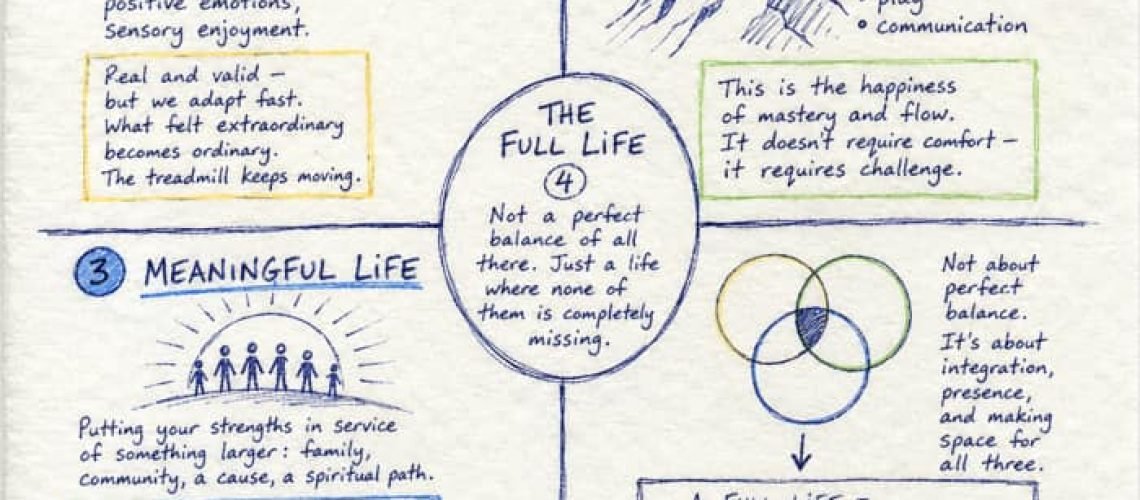
He identified four orientations toward happiness:
- The pleasant life
- The good life
- The meaningful life
- The full life
These are not stages, personal preferences, or genetic conditions. They are just different sources, four different flavors of what a good life can look like. Each one is real and valid. And most of us are overinvested in one (or maybe two) at the expense of the others.
The Pleasant Life
This is the happiness of the senses. Good food, beautiful surroundings, comfort, pleasure, positive emotions. There’s nothing superficial about wanting these things. They’re wired into us and make us happy.
The catch is that we easily get used to them. We adapt and take them for granted. You enjoy the fancy restaurant, then you want a different one. You experience a piece of art that moves you, and then that piece no longer moves you in the same way. It’s kind of a hedonic treadmill. What once felt extraordinary becomes ordinary, and your nervous system starts looking for the next thing.
The pleasant life is a real and valid part of a full life. But if it’s your primary strategy for happiness, you’ll notice a certain restlessness that never quite settles.
The Good Life
This is where mastery lives.
The good life is about using your strengths and talents in the things that matter: your work, your relationships, how you play, how you communicate. Seligman draws heavily here on the concept of flow, developed by Mihaly Csikszentmihalyi: that state where you’re fully absorbed in a challenge that stretches you just enough.
What makes this different from the pleasant life is that it doesn’t require comfort (actually, you will need to get uncomfortable). And yes: you can be in flow while doing something hard. In fact, the difficulty is part of it. You feel the gratification of getting better. Of being more today than you were last month.
By the way: language learning, skill-building and learning new things, all that lives here. It’s part of the good life.
How much mastery are you building right now (not only in your work, but in your entire life, including relationships, hobbies, skills in general)?
The Meaningful Life
The third orientation is the deepest and, according to Seligman, the most durable.
The meaningful life is not about feeling good. It’s about your strengths being in service of something larger than yourself. It could be your family, a community, a cause. It can even be a spiritual path. Something that would matter even if no one was watching and you felt no immediate reward.
This is where the most resilient happiness lives. People who find meaning in what they do are less dependent on circumstances going well. They are going to do something with whatever comes their way.
How much meaning are you finding in your daily life?
The Full Life
Seligman’s fourth orientation isn’t really a separate happiness type. It’s the integration of the first three.
The full life is not a perfect balance where you allocate equal time to pleasure, mastery, and meaning. The full life is simply one where none of the three is completely missing. You can move between them. You can tap into each one when you need it.
Some seasons of life are more about flow and skill-building. Others are more about meaning and contribution. Others, honestly, are about rest and pleasure. What matters is that you don’t cut off access to any of them entirely and permanently.
A Few Questions to Consider
Think of these three buckets:
Bucket 1: The pleasant life. Positive emotions, pleasure, sensory enjoyment.
- Are you getting enough of this?
- Or are you so focused on productivity and purpose that you’ve forgotten to enjoy the things in front of you?
Bucket 2: The good life. Mastery, skill-building, flow.
- Are you growing?
- In your work, yes, but also in how you relate, how you communicate, how you play?
Bucket 3: The meaningful life. Putting your strengths in service of something larger.
- Are you connected to something that matters beyond your own wellbeing?
Now, looking at these three:
which one is most neglected right now?
The point isn’t to immediately restructure everything. The point is to notice. Because once you can see which bucket is running low, you have something to work with.